
THEORY & PRACTICE · CHAPTER 06
Mandala drawing & integration
Creative expression, sharing, and making space to reflect after a session.
3 min read
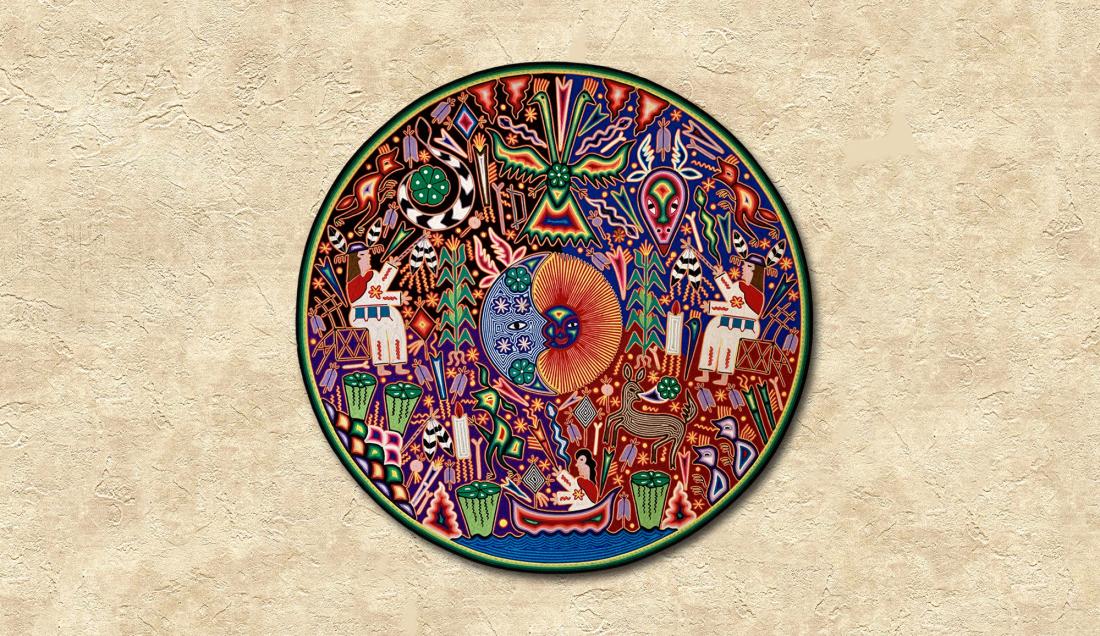
Making space afterwards is part of the practice. Drawing, reflection and sharing offer different ways to express an experience without needing to explain it immediately.
Adapted from the theoretical article by Stanislav Grof already published on this site. The first-person passages describe the author’s perspective and observations, not established explanations for every experience or promises of treatment. This is background reading, not a guide to practising alone.
Making a mandala
When the session is completed and the breather returns to the ordinary state of consciousness, the sitter accompanies him or her to the mandala room. This room is equipped with a variety of art supplies, such as pastels, magic markers, and water colors, as well as large drawing pads. On the sheets of these pads are pencil drawings of circles about the size of dinner plates. The breathers are asked to sit down, meditate on their experience, and then find a way of expressing what happened to them during the session.
There are no specific guidelines for the mandalas. Some people simply produce color combinations, others construct geometrical mandalas or figurative drawings or paintings. The latter might represent a vision that occurred during the session or a pictorial travelogue with several distinct sequences. On occasion, the breather decides to document a single session with several separate mandalas. In rare instances, the breather does has no idea what he or she is going to draw and produces an automatic drawing.
We have seen instances when the mandala did not illustrate the preceding session, but actually anticipated the experience from a future one. This is in congruence with C. G. Jung's idea that the products of the psyche can not be fully explained from preceding historical events. In many instances, they have not just a retrospective, but also a prospective aspect. Some mandalas thus reflect a movement in the psyche that Jung called the individuation process and reveal its forthcoming stage.
Sharing without fixed interpretations
Later during the day, breathers bring their mandalas to a sharing session, in which they talk about their experiences. The strategy of the facilitators who lead the group is to encourage maximum openness and honesty in sharing the experience. Willingness of participants to reveal the content of their sessions, including various intimate details, is conducive to bonding and development of trust in the group; it deepens, intensifies, and expedites the therapeutic process.
In contrast with the practice of most therapeutic schools, facilitators abstain from interpreting the experiences of participants. The reason for it is the lack of agreement concerning the functioning of the psyche among the existing schools. We discussed earlier that under these circumstance any interpretations are questionable and arbitrary. Another reason for staying away from interpretations is the fact that psychological contents are overdetermined and meaningfully related to several levels of the psyche. Giving a supposedly definitive explanation or interpretation carries the danger of freezing the process and interfering with therapeutic progress.
A more productive alternative is to ask questions that help to elicit additional information from the perspective of the client who, being the experiencer, is the ultimate expert as far as his or her experience is concerned. When we are patient and resist the temptation to share our own impressions, participants very often find their own explanations that best reflect their experiences. On occasion, it can be very helpful to share our observations from the past concerning similar experiences or point out connections with experiences of other members of the group. When the experiences contain archetypal material, using C. G. Jung's method of amplification - referring to parallels between a particular experience and similar mythological motifs from various cultures - or consulting a good dictionary of symbols might be very helpful.
Further reading
Stanislav Grof, “Theory and Practice of Holotropic Breathwork,” Journal of Transpersonal Research, 2014, 6(1), 7–24. For the framework of facilitated practice, see the Principles of Holotropic Breathwork.
FROM UNDERSTANDING TO EXPERIENCE
Curious about a workshop?
Explore upcoming dates, or talk with us about what to expect.
Explore workshops