EXPLORE & UNDERSTAND
Holotropic Breathwork® – A profound path, not just a practice
Six interconnected influences, and the depth of training behind the practice.
3 min read
Holotropic Breathwork® is more than a “breathwork technique”. Rooted in diverse wisdom traditions and psychological approaches, it is part of the Holotropic Paradigm—a framework for healing, self-exploration and moving towards wholeness.
Its depth comes from the meeting of different ways of understanding human experience. The diagram below offers one way of mapping six interconnected influences.
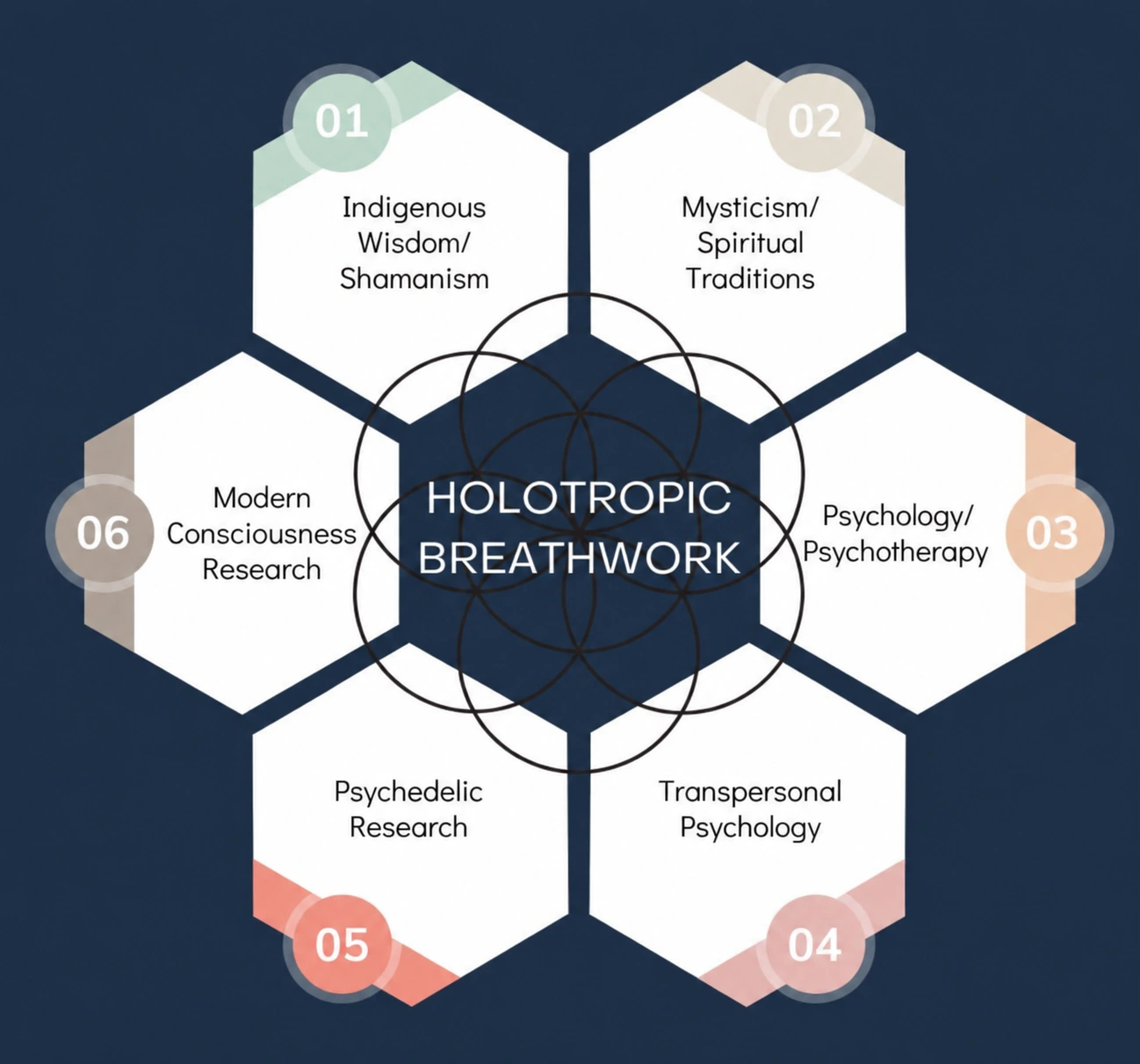
Six interconnected influences
01 · Indigenous wisdom & shamanism
The Holotropic Paradigm honours ancestral traditions that explore healing and transformation through expanded states of consciousness. This perspective also emphasises the inner capacities for healing within each person, offering pathways to reconnect with them. These diverse traditions deserve respect within their own cultural contexts.
02 · Mysticism & spiritual traditions
Drawing insights from rich spiritual lineages, including ancient mystery traditions, world religions and their texts, the approach offers a framework for exploring mystical experiences. Participants do not need to adopt a particular spiritual belief.
03 · Psychology & psychotherapy
The Holotropic Paradigm integrates insights from modern psychology and psychotherapy without being bound to a single school. Attention to the body, emotional expression and creative practices can support exploration and integration. A trauma-sensitive approach places importance on consent, personal boundaries and choice.
04 · Transpersonal psychology
Exploring aspects of human experience that extend beyond the personal or ego-centred self, transpersonal psychology considers spiritual, mystical and expansive dimensions of consciousness. Read our introduction to transpersonal psychology.
05 · Psychedelic research
Informed by the pioneering work of psychiatrist Dr Stanislav Grof with LSD-assisted therapy, Holotropic Breathwork® offers a non-substance-based approach to self-exploration. This does not mean it is risk-free: participation screening and appropriately trained facilitation remain important.
06 · Modern consciousness research
Questions about consciousness invite dialogue with contemporary psychology, neuroscience and the study of human experience. This is an ongoing inquiry, not a claim that scientific research has established every interpretation within the Holotropic Paradigm.
Why the training takes time
Becoming a GTT Holotropic Breathwork® facilitator is a journey of study, personal transformation and ongoing practice. GTT specifies a minimum of two years in training, beginning with the first module, with additional requirements including experiential workshops, consultations, ethics, supervised apprenticeships for practitioners and a closing certification intensive. Read GTT’s training requirements.
Certification is not a licence to practise psychotherapy. It marks training in this particular approach, with continuing learning and practice remaining part of a facilitator’s path.
More than a certificate, this is a commitment to showing up with care, humility and respect for each person’s experience.
Continue exploring
Read what happens in Holotropic Breathwork®, explore the history of the practice, or watch the films and conversations in our video collection. For the practice’s own theoretical framework, see GTT’s introduction and its practitioner ethical agreements.
FROM UNDERSTANDING TO EXPERIENCE
Curious about a workshop?
Explore upcoming dates, or talk with us about what to expect.
Explore workshops