
THEORY & PRACTICE · CHAPTER 04
Bodywork & supportive presence
The original theory of focused energy release, alongside consent and personal choice.
9 min read
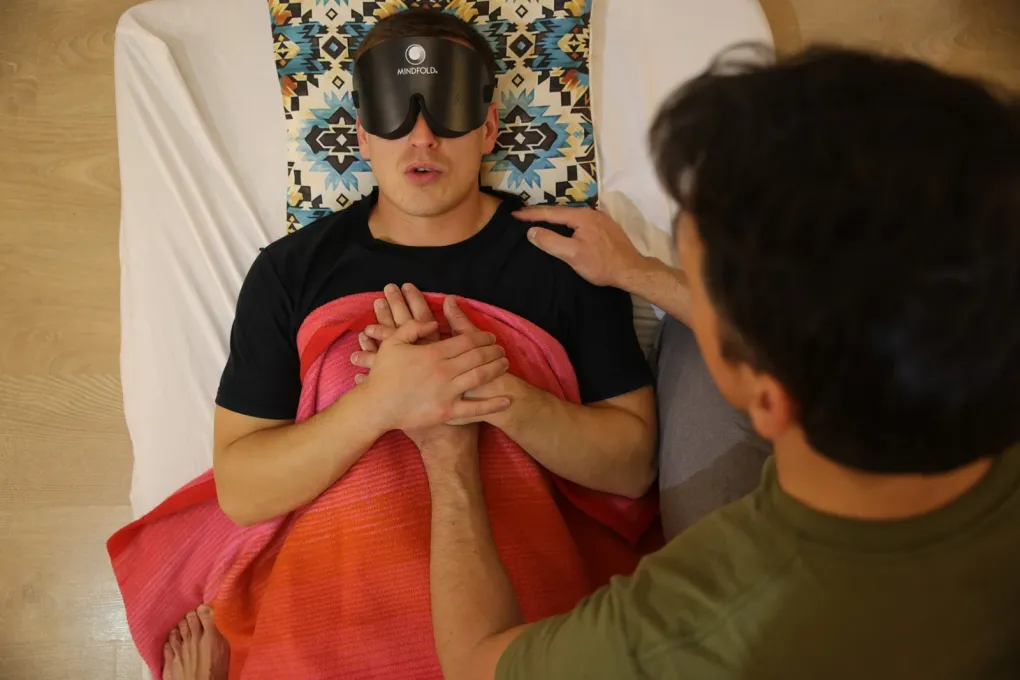
Focused bodywork is described in the holotropic framework as support for a participant’s process. It belongs within trained facilitation, with boundaries discussed beforehand.
Consent comes first. Participation and any physical contact are choices, not obligations. A participant may decline or withdraw consent. The practitioners’ ethical agreements emphasise personal autonomy and the limits of a facilitator’s competence.
The older article uses concepts such as “energy release” and “regression.” These are theoretical interpretations, not proof of the cause of physical symptoms or a substitute for medical assessment.
Adapted from the theoretical article by Stanislav Grof already published on this site. The first-person passages describe the author’s perspective and observations, not established explanations for every experience or promises of treatment. This is background reading, not a guide to practising alone.
The author’s view of physical experience
In his original account, Grof interprets changing physical sensations through the framework of emotional expression and “energy release.” This is the author’s theoretical model; it should not be used to dismiss physiological explanations for overbreathing or to decide whether symptoms require clinical care.
Expression and focused energy release
The tensions that we carry in our body can be released in two different ways. The first of them involves catharsis and abreaction - discharge of pent-up physical energies through tremors, twitches, dramatic body movements, coughing, gagging, and vomiting. Both catharsis and abreaction also typically include release of blocked emotions through crying, screaming, or other types of vocal expression. These are mechanisms that are well-known in traditional psychiatry since the time when Sigmund Freud and Joseph Breuer published their studies in hysteria (Freud and Breuer 1936). They have been used in traditional psychiatry in the treatment of traumatic emotional neuroses and represent an integral part of the new experiential psychotherapies, such as the neo-Reichian work, Gestalt practice, and primal therapy.
The second mechanism that can mediate release of physical and emotional tensions plays an important role in holotropic breathwork, rebirthing, and other forms of therapy using breathing techniques. It represents a new development in psychiatry and psychotherapy and seems to be in many ways more effective and interesting. Here the deep tensions surface in the form of transient muscular contractions of various duration. By sustaining these muscular tensions for extended periods of time, the organism consumes enormous amounts of previously pent-up energy and simplifies its functioning by disposing of them. The deep relaxation that typically follows the temporary intensification of old tensions or appearance of previously latent ones bears witness to the healing nature of this process.
These two mechanisms have their parallels in sport physiology, where it is well known that it is possible to do work and train the muscles in two different ways - by isotonic and isometric exercises. As the name suggest, during isotonic exercises the tension of the muscles remains constant while their length oscillates. During isometric exercises, the tension of the muscles changes, but their length remains the same all the time. A good example of isotonic activity is boxing, while weight-lifting is distinctly isometric. Both of these mechanisms are extremely effective in releasing and resolving muscular tension. In spite of their superficial differences, they have thus much in common and in holotropic breathwork they complement each other very effectively.
In many instances, the difficult emotions and physical manifestations that emerge from the unconscious during holotropic sessions get automatically resolved and the breathers end up in a deeply relaxed meditative state. In that case, no external interventions are necessary and they remain in this state until they return to an ordinary state of consciousness. After a brief check with the facilitators, they move to the art room room to draw a mandala.
If the breathing, in and of itself, does not lead to a good completion and there are residual tensions or unresolved emotions, facilitators offer participants a specific form of bodywork which helps them to reach a better closure for the session. The general strategy of this work is to ask the experient to focus his or her attention on the area where there is a problem and do whatever is necessary to intensify the existing physical sensations. The facilitator then helps to intensify these feelings even further by appropriate external intervention.
While the attention of the breather is focused on the energetically charged problem area, he or she is encouraged to find a spontaneous response to this situation. This response should not reflect a conscious choice of the breather, but be fully determined by the unconscious process. It often takes an entirely unexpected and surprising form - voice of a specific animal, talking in tongues or an unknown foreign language, shamanic chant from a particular culture, or baby talk. Equally frequent are completely unexpected physical reactions, such as violent tremors, jolts, coughing, and vomiting, as well as typically animal movements. It is essential that the facilitators simply support this process, rather than apply some technique offered by a particular school of therapy. This work continues until the facilitator and the breather reach an agreement that the session has been adequately closed.
Supportive contact and personal boundaries
In holotropic breathwork® we also use supportive physical contact. This is based on the observation that there exist two fundamentally different forms of trauma that require diametrically different approach. This first of these can be referred to as 'trauma by commission.' It involves external intrusions that had unfavorable impact on future development of the individual, such as physical or sexual abuse, frightening situations, destructive criticism, or ridicule. These traumas represent foreign elements in the unconscious that can be brought into consciousness, energetically discharged, and resolved.
Although this distinction is not recognized in conventional psychotherapy, the second form of trauma, 'trauma by omission,' is radically different. It actually involves the opposite mechanism - lack of positive experiences that are essential for a healthy emotional development. The infant, as well as an older child, have strong primitive needs for instinctual satisfaction and security that pediatricians and child psychiatrists call 'anaclitic' (from the Greek anaklinein meaning to lean upon). These involve the need to be held, caressed, comforted, be played with, and be the center of human attention. When these needs are not met, it has serious consequences for the future of the individual.
Supportive contact is one possible element of this approach, not the only way to address a history of trauma. It must be appropriate to the individual, freely agreed, and never presented as something a participant has to accept in order to benefit.
Use of nourishing physical contact is a very effective way of healing early emotional trauma. However, it requires following strict ethical rules. We have to explain to the breathers before the session the rationale of this technique and get their approval to use it. Under no circumstances can this approach be practiced without previous consent and no pressures can be used to obtain this permission. For many people with a history of sexual abuse, physical contact is a very sensitive and charged issue. Very often those who need it most have the strongest resistance to it. It can sometimes take a long time before a person develops enough trust toward the facilitators and the group to be able to accept this technique and benefit from it.
Supportive physical contact has to be used exclusively to satisfy the needs of the breathers and not those of the sitters or facilitators. By this I do not mean only sexual needs or needs for intimacy which, of course, are the most obvious issues. Equally problematic can be a strong need to be needed, loved, or appreciated, unfulfilled maternal need, and other less extreme forms of emotional wants and desires. I remember an incident from one of our workshops at the Esalen Institute in Big Sur, California, which can serve as a good example.
At the beginning of our five-day seminar, one of the participants, a postmenopausal woman, shared with the group how much she had always wanted to have children and how much she suffered because this had not happened. In the middle of the holotropic session, in which she was a sitter for a young man, she suddenly pulled the upper part of her partner's body into her lap and started to rock and comfort him. Her timing could not have been worse; as we found out later during the sharing, he was at the time in the middle of a past life experience that featured him as a powerful Viking warrior on a military expedition.
It usually is quite easy to recognize when a breather is regressed to early infancy. In a really deep age regression, all the wrinkles in the face tend to disappear and the individual might actually look and behave like an infant. This can involve various infantile postures and gestures, as well as hypersalivation and sucking. Other times, the appropriateness of offering physical contact is obvious from the context, for example, when the breather just finished reliving biological birth and looks lost and forlorn. The maternal needs of the woman in the Esalen workshop were so strong that they took over and she was unable to objectively asess the situation and act appropriately.
The author’s perspective on memory
Before closing this section on bodywork, I would like to address one question that often comes up in the context of holotropic workshops or lectures on experiential work: "Since reliving of traumatic memories is typically very painful, why should it be therapeutic rather than represent a retraumatization?" I believe that he best answer can be found in the article Unexperienced Experience by the Irish psychiatrist Ivor Browne and his team (McGee et al. 1984). He suggested that we are not dealing here with an exact replay or repetition of the original traumatic situation, but with the first full experience of the appropriate emotional and physical reaction to it. This means that, at the time when they happen, the traumatic events are recorded in the organism, but not fully consciously experienced, processed, and integrated.
In addition, the person who is confronted with the previously repressed traumatic memory is not any more the helpless and vitally dependent child or infant he or she was in the original situation, but a grown up adult. The holotropic state induced in powerful experiential forms of psychotherapy thus allows the individual to be present and operate simultaneously in two different sets of spacetime coordinates. Full age regression makes it possible to experience all the emotions and physical sensations of the original traumatic situation from the perspective of the child, but at the same time analyze and evaluate the memory in the therapeutic situation from a mature adult perspective.
Further reading
Stanislav Grof, “Theory and Practice of Holotropic Breathwork,” Journal of Transpersonal Research, 2014, 6(1), 7–24. For the framework of facilitated practice, see the Principles of Holotropic Breathwork.
FROM UNDERSTANDING TO EXPERIENCE
Curious about a workshop?
Explore upcoming dates, or talk with us about what to expect.
Explore workshops